
Most fieldwork problems are predictable. Planning for them explicitly is what separates a clean dataset from a compromised one.
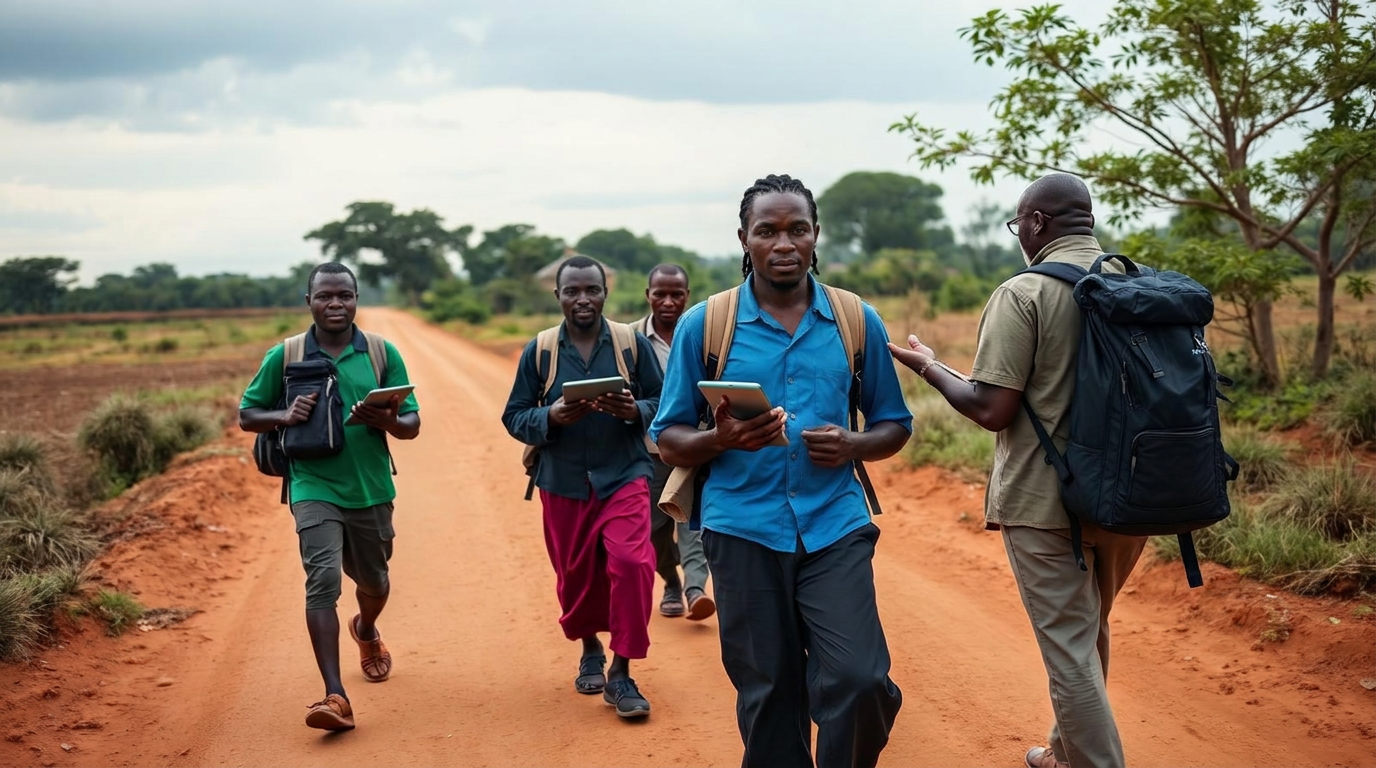
The recurring ten
Across household surveys, facility assessments and community research, the same operational risks recur. Naming them in the field plan makes them manageable.
- Inaccurate or outdated sampling lists. Reconcile and re-list before mobilisation.
- Respondent unavailability. Define replacement rules in advance rather than in the field.
- Community entry delays. Secure county and local approvals before deployment.
- Enumerator drift from protocol. Use refresher briefings and supervisor observation.
- Connectivity gaps. Choose tools that support offline capture and staged upload.
- Device and power failure. Carry spare devices and power banks per team.
- Long questionnaires causing fatigue. Cut modules that no indicator depends on.
- Sensitive questions and social desirability bias. Use careful phrasing, matched interviewers and private settings.
- Translation inconsistency. Agree fixed, tested translations rather than interpreting on the spot.
- Late error detection. Run daily dashboards and same-week back-checks.
Fix problems while teams are still in the field
The value of digital data collection is not the tablet but the feedback loop. When submissions are reviewed daily, an enumerator misapplying a skip pattern can be corrected on day two rather than discovered during analysis.
Build a simple daily monitoring routine: submission counts by team, interview duration outliers, missing-value rates, GPS plausibility and back-check discrepancy rates.
Treat field teams as part of the quality system
Enumerators are the instrument. Training should include the purpose of the study, not just the mechanics of the questionnaire, teams that understand why a question exists ask it better. Fair pay, realistic daily targets and responsive supervision do more for data quality than any post-hoc cleaning routine.
Budget for quality, not just coverage
Field budgets in Kenya are often built around a target number of completed interviews and little else. The items that actually protect data quality, supervisor accommodation near the teams, airtime and data bundles for daily uploads, replacement visits, back-check travel, are the first to be cut when costs tighten.
A realistic fieldwork budget prices quality assurance as a line item. If the budget cannot support at least daily data review and a defined back-check rate, reduce the sample size rather than the supervision.
When to bring in a field partner
Organizations running occasional studies often underestimate the operational load of fieldwork: enumerator recruitment and vetting, county approvals, community entry, device management, daily monitoring and back-check coordination all run in parallel for the duration of data collection.
A field partner earns its fee on exactly these problems. If your team cannot dedicate someone full time to field supervision and data review for the whole collection period, outsourcing fieldwork is usually cheaper than repeating a compromised study.
Frequently asked questions
- How many interviews should be back-checked in a survey?
- A common standard is 10 to 15 percent of completed interviews per enumerator, spread across the fieldwork period rather than done at the end. Back-checks should verify that the interview took place and re-ask a small set of factual questions to detect fabrication.
- What is the best tool for offline data collection in Kenya?
- KoboToolbox and SurveyCTO are the most widely used. Both work fully offline and sync when connectivity returns. KoboToolbox suits budget-constrained studies; SurveyCTO offers stronger built-in quality control for large or high-stakes surveys.
- How long should a household questionnaire be?
- Keep core interviews under 45 to 60 minutes. Beyond that, respondent fatigue measurably reduces data quality. If the instrument is longer, cut modules that no indicator in the results framework depends on.
- Do we need county approval for fieldwork in Kenya?
- For most community-level research, yes. Budget time for county government notification or approval, and for national research licensing through NACOSTI where the study requires it. Community entry through local administrators should happen before enumerators arrive.
- How do you prevent enumerators from fabricating interviews?
- Layered controls work best: GPS capture on every submission, interview duration monitoring, audio audits on a sample of interviews, back-checks on 10 to 15 percent of work, and same-week review so problems are corrected while teams are still deployed.